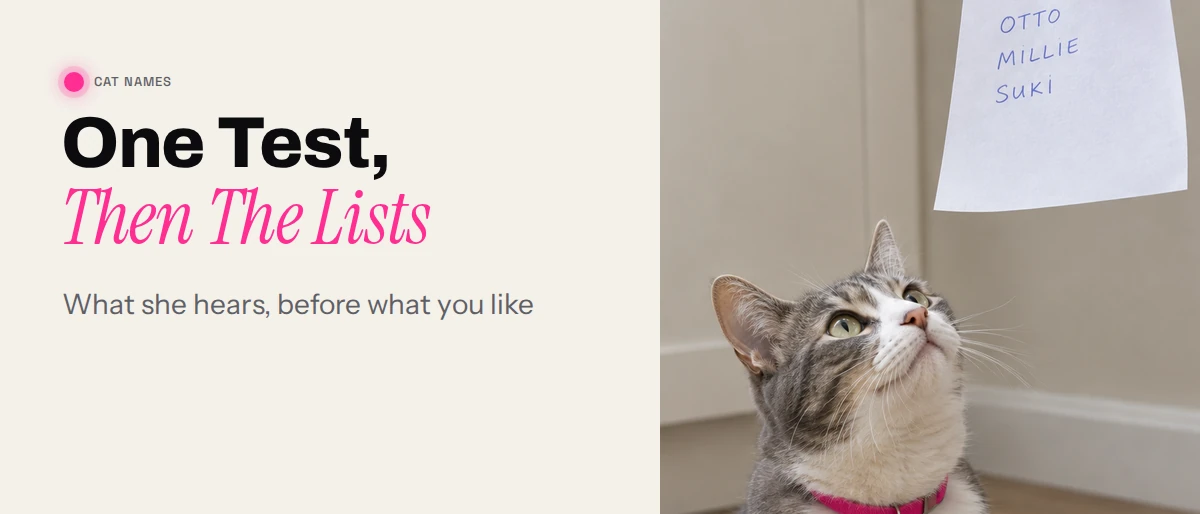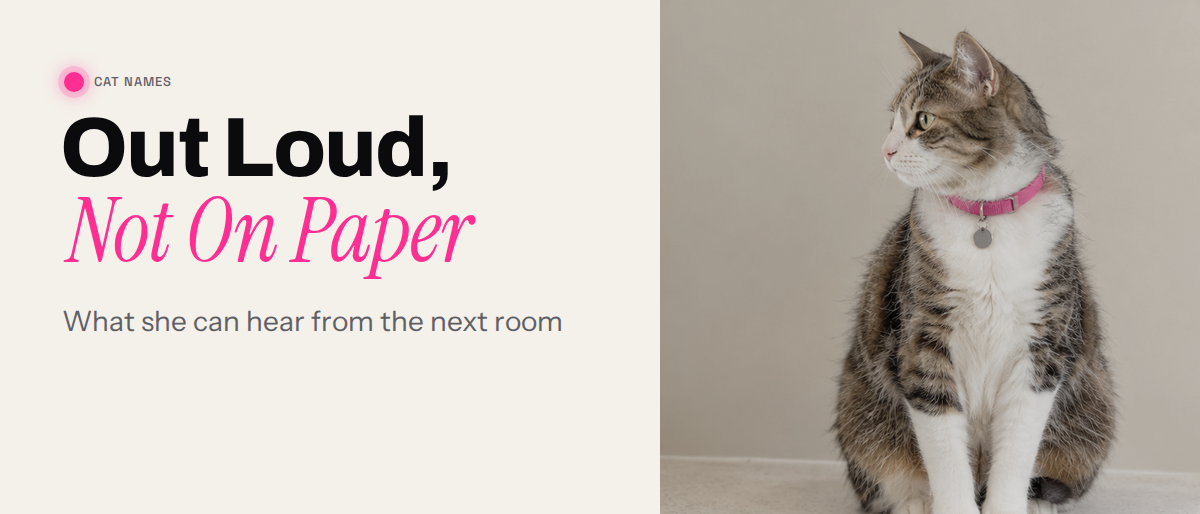
Girl cat names are mostly chosen for how they look written down, which is the one test the name will never have to pass.
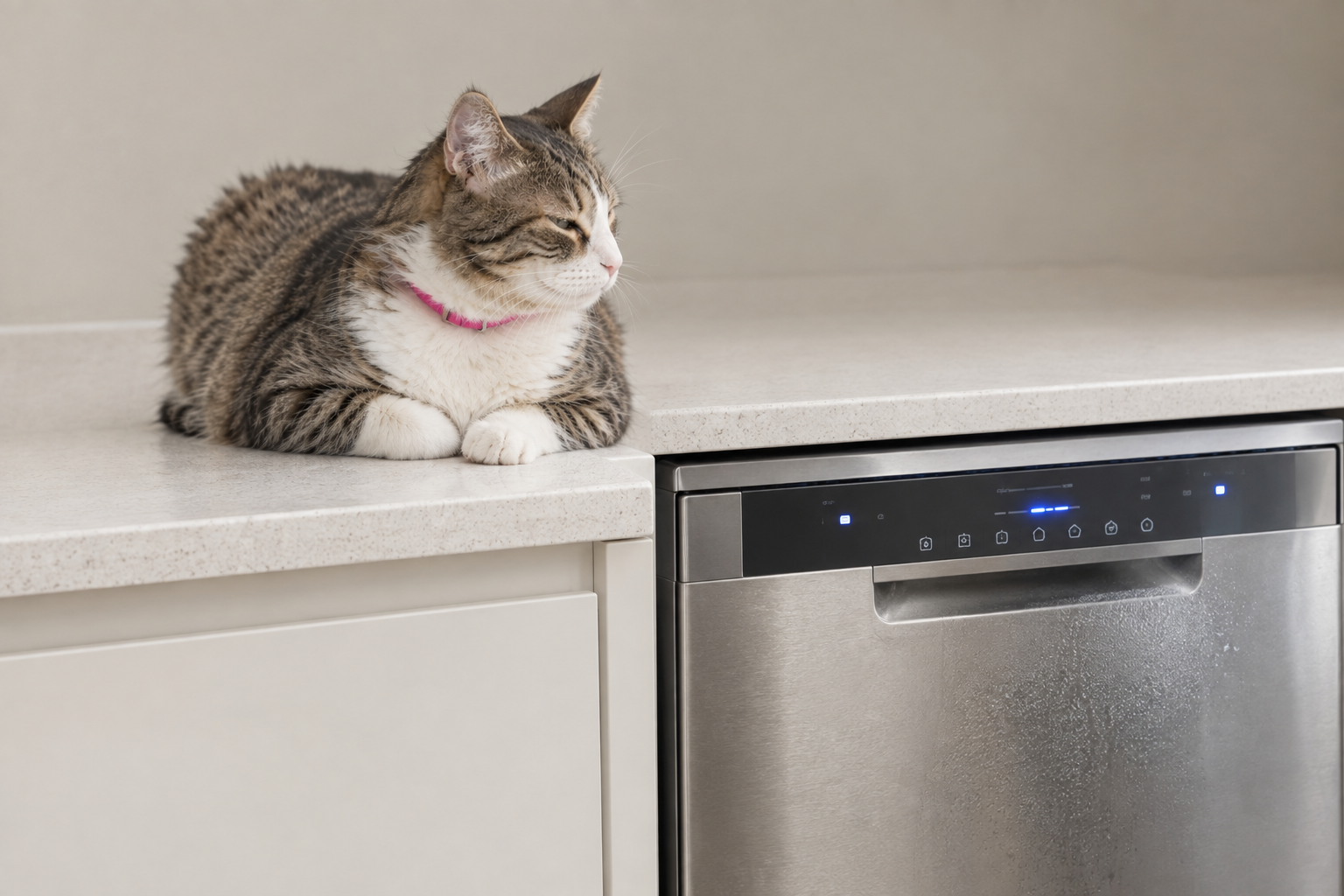
She is not going to read it. She is going to hear it once, across a kitchen, over a dishwasher, while weighing it against whatever she is already doing. Female cat names get judged on a page and then used in a room, and the two do not reward the same qualities.
What decides whether she turns is how sharply the sound starts and where it sits in her hearing, an argument that belongs to the cat names hub and is the same for every cat in the house.
What is specific to this page is narrower and more annoying. The conventions that cluster around naming a female cat push almost entirely toward soft, open, unhurried sounds. Those are the ones that lose.
Do girl cat names need to sound soft?
No, and softness works against her, because a sound that fades in has less to cut through a room with.
The hub sets out the mechanism and sources it: she hears a wider range than you do, and the part of your voice that reaches her cleanly is the top of it. What follows from that is an argument rather than a finding, so take it as one. A name opening on a breath has no attack. Seraphina, Willow, Aurora and Amelia are lovely on a page and all four begin with a sound that fades in rather than arriving. In a quiet room that costs nothing. Over a faucet, a television and a fridge motor, the front of the word is gone and she hears the tail of something.
Compare that with Bea, Nettle, Mabel, Ziggy or Hattie. None of them is delicate and all of them start on a hard edge she can locate.
Delicacy is a visual quality. It does not survive being spoken across a room, and it was never going to.
Which female cat names actually cut through?
Ones with a hard consonant at the front, or a bright vowel at the end, and preferably both.
Two shapes do most of the work. The first is an "ee" ending, which sits high and holds its pitch: Millie, Effie, Suki, Pixie. The second is a hard front on two syllables, which gives her an edge to locate and a second beat to confirm it: Kiki, Dora, Coco, Peggy.
The test takes ten seconds. Say it from the next room in your ordinary voice, then say it again the way you would if you were pleased to see her. If only the second one gets an ear, the name is fine and your delivery was the variable.
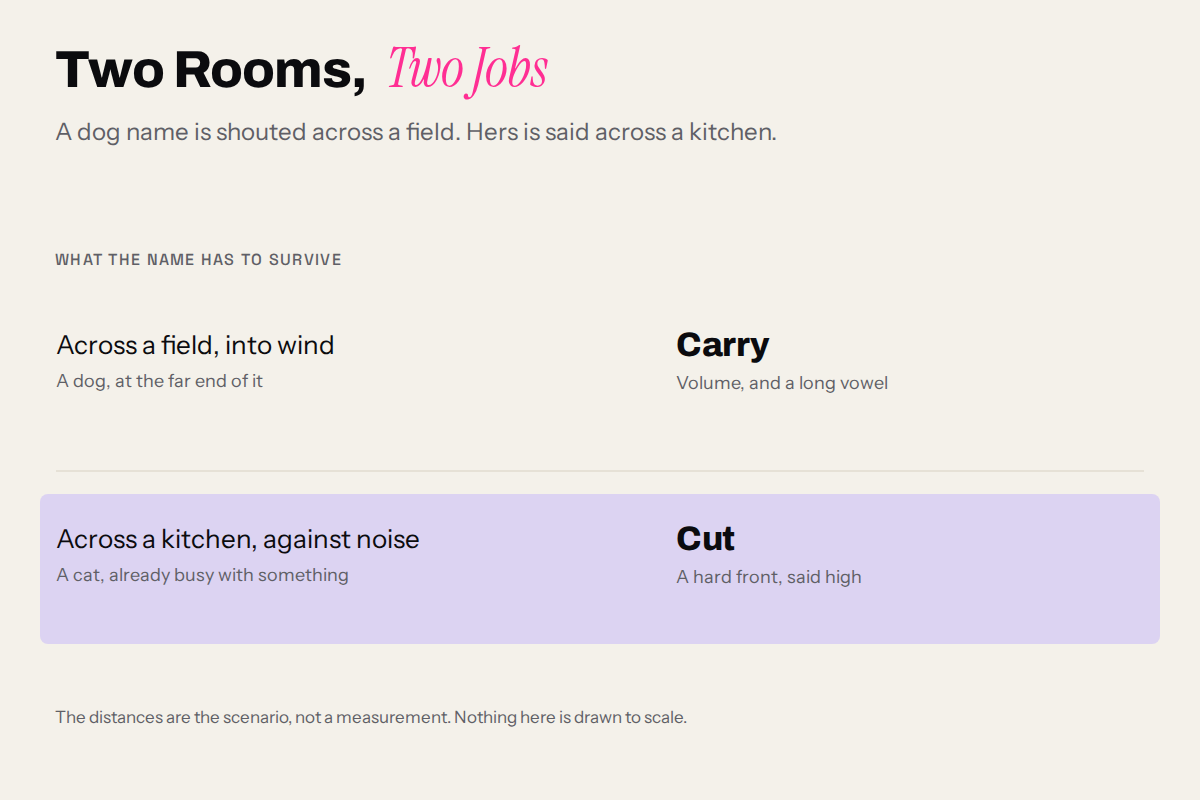
The distance is the thing people get wrong. A dog name is tested at forty feet into wind. Hers is tested at ten feet against noise, and those are different problems with different answers.
Which feminine names for cats cause trouble later?
Ones tied to a kitten trait, and ones that sit too close to the sound you use for food.
Tiny, Squeak and Bitsy are accurate for eleven weeks and then describe nothing for eighteen years. It is the commonest regret and it is entirely avoidable.
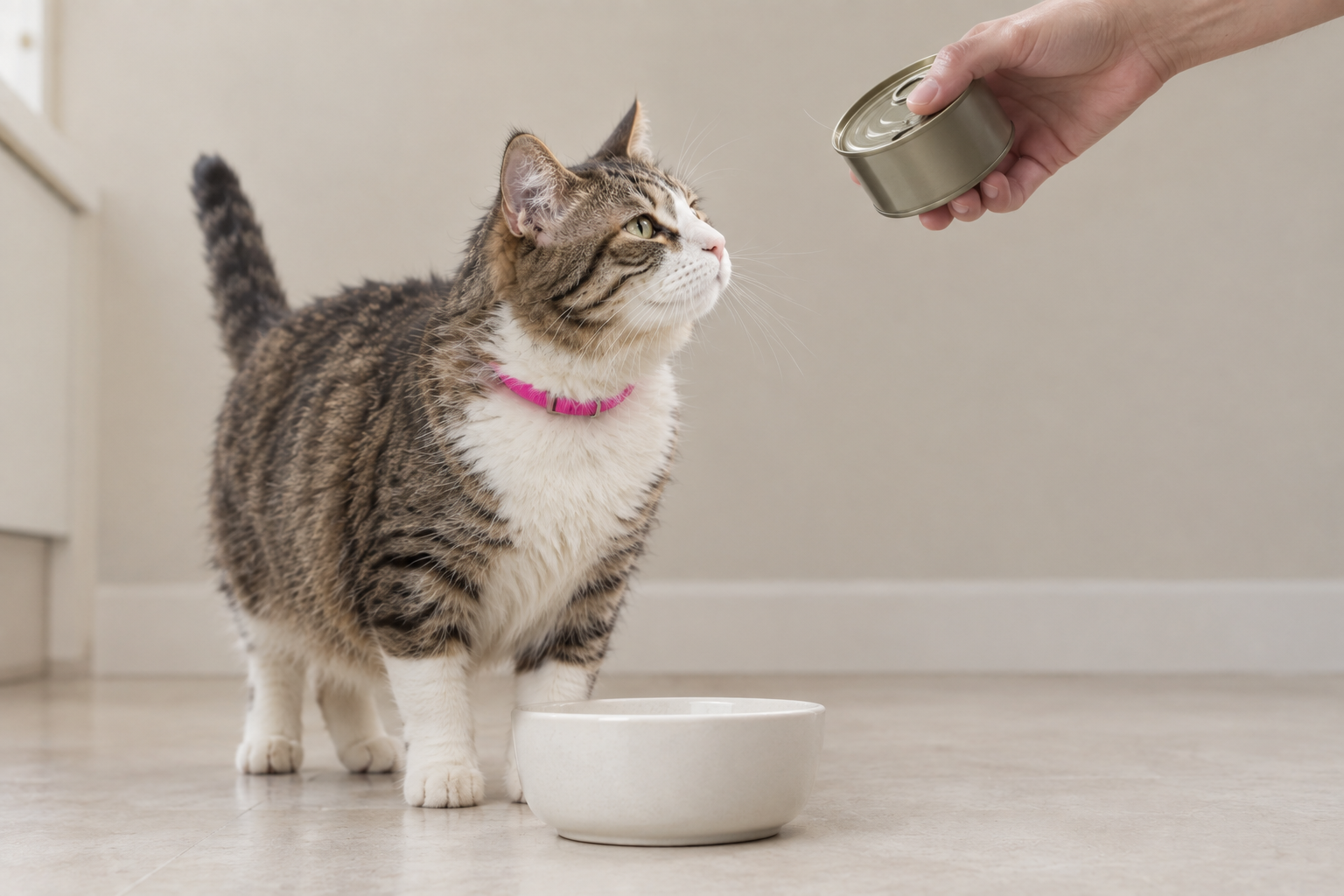
The feeding collision matters more than it sounds. Whatever you use to call her to a bowl, a word, a whistle or a tap on the can, her name should not be a near miss for it. If it is, the sound sometimes means food and sometimes means nothing, and she stops betting on it.
What is not a problem, despite being repeated everywhere: two cats in one house with similar-sounding names. The 2019 study in Scientific Reports found that house cats distinguished their own name from the names of the cats they lived with. The animals that failed that test lived in a cat cafe, and the researchers put it down to visitors using the names interchangeably rather than to the names sounding alike. So Tilly and Milly is fine, as long as Tilly only ever means Tilly.
What should you actually call her?
Names that start on an edge, sit high, and are not a near miss for anything else in the house.
| Shape | Why it works on a cat | Names |
|---|---|---|
| Ends on an "ee" | Sits in the range she hears most clearly and holds pitch | Millie, Effie, Suki, Pixie, Maggie, Dizzy, Betty, Poppy, Rosie, Lucy |
| Hard front, two syllables | A clear attack to locate, then a second beat to confirm it | Kiki, Dora, Coco, Delilah, Gigi, Bonnie, Nala, Kali, Peggy, Tallulah |
| Plant, food and color | Distinct from every other sound anyone says in the house | Nettle, Clover, Saffron, Olive, Pepper, Fig, Juniper, Marmalade, Plum, Hazel |
| One syllable, bright vowel | Short, and the vowel does the carrying that a second syllable would | Short, and the vowel does the carrying that a second syllable would |
| Formal, with a short call name | Dignified on the record, workable at the bowl | Persephone to Sephy, Wilhelmina to Mina, Clementine to Clem, Beatrice to Bea, Guinevere to Gwen, Seraphina to Fina |
| Entirely unserious | Cuts through perfectly and never stops being funny | Susan, Deborah, Janet, Linda, Carol, Brenda, Gloria, Patricia, Sandra, Barbara |
The last row is the sleeper. Susan and Brenda have a hard front, two clean syllables and a plain ending that carries, and on pure audibility they beat most of the pretty names above them.
The row above it is the compromise worth knowing about. Human female names run long, and a cat does not need the long one. Pick the formal version for the paperwork and the short one for the kitchen, and you get both without arguing with yourself.
If she is black or black and white, the black cat names page runs a different test, because a photograph will not identify her on its own. If you are naming a male at the same time, boy cat names is the sibling page.
Where does her name get written down?
On a microchip record, an intake form and a vet file, and almost never the same way twice.
There is no federal requirement to microchip a cat in the US and no national registry standing behind it. The AVMA is direct that implanting the chip is only the first step and the registration has to be completed and kept current. So the record exists only because somebody chose to make it, and the name on it is whatever got typed.
The failure is not one wrong entry. It is four near misses. Millie on the chip, Milly on the insurance, Milli at the clinic and Mil in the boarding book. Each is defensible alone and the set of them matches nothing when someone searches.
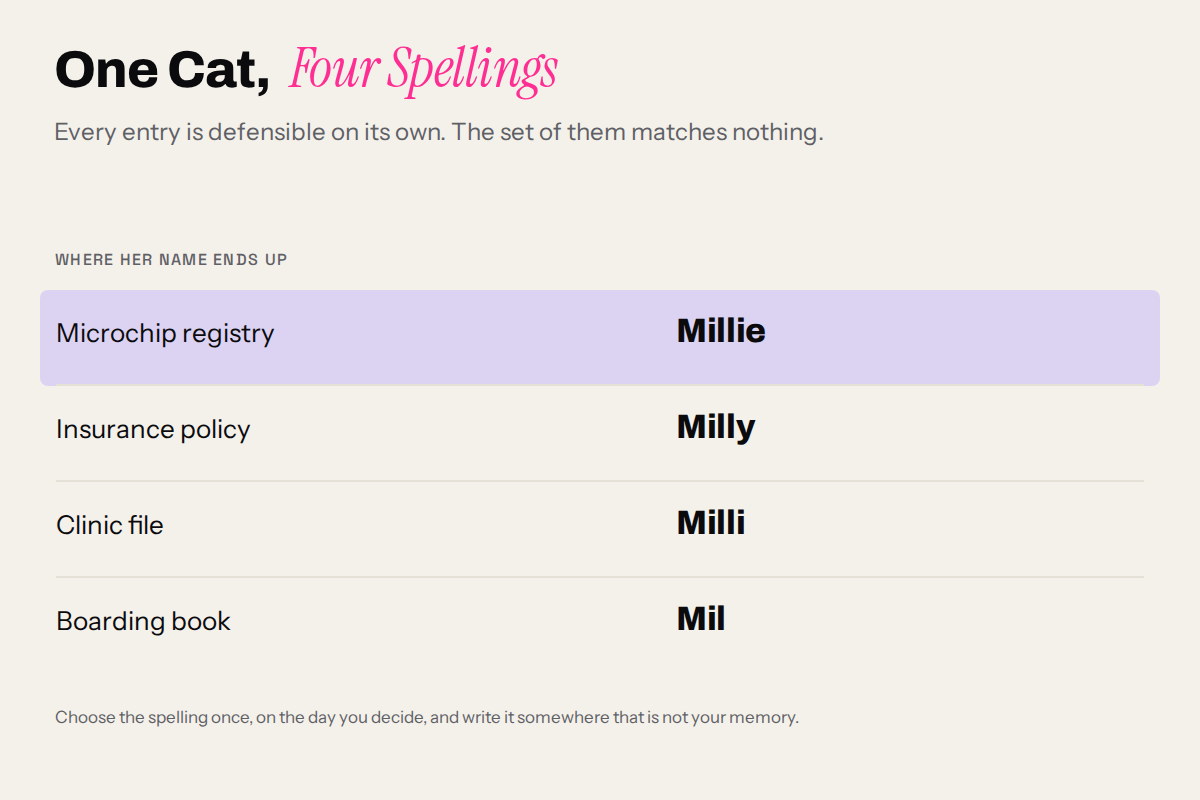
Pick the spelling once, on the day you decide, and keep it somewhere other than your memory. That is harder than it sounds, which is the whole reason this site exists.
What else do people ask about naming a female cat?
Is a girl cat name any different from a boy cat name?
Acoustically, none. A cat has no idea which category the sound belongs to. The difference is entirely in the conventions people bring, and those conventions push girl names toward softer sounds, which is a handicap rather than a style.
Do long formal names work on a cat?
Yes, if you decide the short version at the same time rather than discovering it later. The problem with Persephone is not Persephone, it is ending up with four improvised shortenings none of which she has learned.
Should her name match her coat?
Only if you would still like it in six months. Coat-based names date faster than people expect, because a kitten's coat often is not the coat she keeps.
What if she does not respond to the name I chose?
Give it two weeks of pairing the sound with food before concluding anything. The same study found that not responding is not the same as not recognizing, and the researchers name motivation as the likelier explanation.