Here is the thing nobody warns you about when you bring a pet home.
None of it is hard.
Pet care is not one job. It is nine or ten, and not one of them is difficult on its own. Feeding a dog is not hard. Flea and tick treatment is not hard either, and even the ones who take it personally have forgiven you by dinner.
A dog grooming routine sounds like a salon and is mostly your own two hands. Brushing a dog's teeth sounds ridiculous for about a week and then becomes something you do while the coffee brews.
What is hard is remembering. Those nine or ten jobs run on nine or ten different clocks.
You were told about each one exactly once. Out loud. In a room. By a veterinarian who was already halfway to the next appointment while you stood there holding a leash, a carrier, a card reader and an animal who had just peed on the floor.
Ask an owner when their dog was last dewormed and watch what happens. There is a pause, then a guess, and the guess goes up at the end like a question, because they know it is a guess as well as you do.
That is not carelessness. The date was never written down anywhere, and a date you cannot find is the same as a date you never had.
So this page is the list. What needs doing, roughly when, and the part people usually get wrong about each one, which is the useful bit. It is not a replacement for your veterinarian. Where something needs a phone call today rather than a think about it later, it says so.
Which dog vaccines are absolutely necessary?
Four viruses plus rabies, and the four ride together in one combination shot labeled DHPP or DAPP depending on the clinic.
Those four are distemper, adenovirus, parvovirus and parainfluenza, and AAHA calls them core along with rabies, which means every dog rather than only the ones with a particular lifestyle.
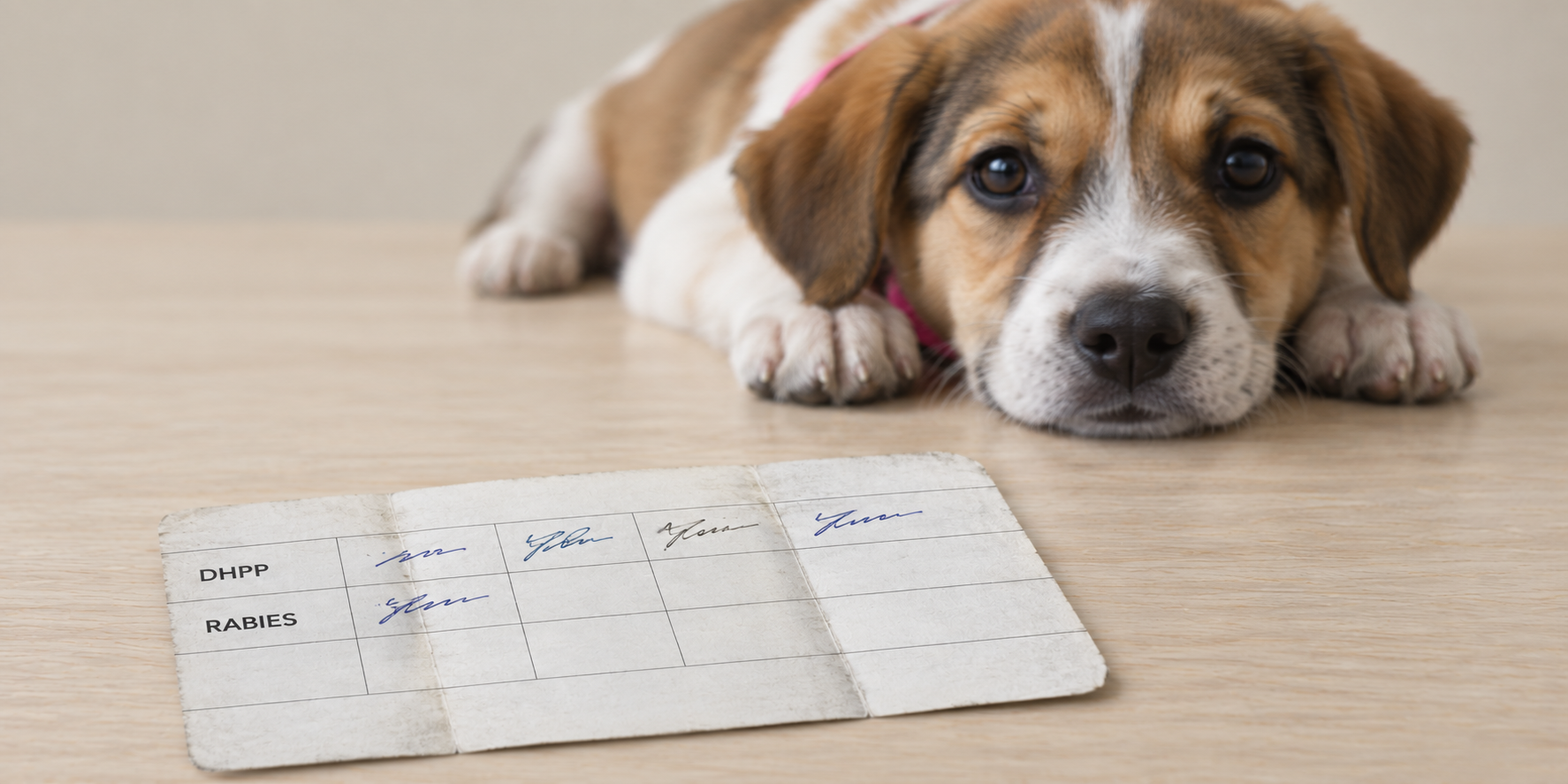
Rabies is the one that is usually a legal requirement rather than a medical recommendation, and the rule is set by state or local law rather than by your veterinarian, so it is different depending on where you live. It is also the single most common thing missing from a page like this, which is odd, because it is the only one anybody can fine you over.
Two sources disagree on how wide that requirement runs, so this page does not put a number on it. Ask your clinic what your state and your county actually require, because that is the version that applies to you.
The schedule surprises people. Merck's puppy care guidance is that puppies need vaccinating every two to three weeks until they are about four months old, which is a longer run of appointments than a first-time owner tends to be braced for.
The other surprise is that the annual visit is not all annual. AAHA's canine vaccination guidelines say veterinarians no longer require annual boosters for every vaccine and that the profession is moving to a three year protocol where it can, with distemper, parvovirus and rabies immunity lasting at least three years after the initial series and the one year booster. The appointment is annual because the practice runs on a year, not because every vial in it does.
Here is the part worth knowing. It is easy to treat the reminder text as the schedule, and it is not the schedule. It is one clinic, reminding you about one animal, out of their system.
Move house, change vets, or have your practice bought by a group and rebranded, and that reminder stays with them rather than following your pet. That is where the gaps come from, and nobody notices until somebody else asks for the dates. What the schedule looks like in full has a hub of its own, and how long to wait after the last puppy shot is a separate question with a separate answer.
How often do fleas, ticks and worms need treating?
On the product's clock rather than the animal's, and the product decides whether that is monthly or every three months.
This one runs on the shortest clock and gets forgotten the most. Fleas, ticks and intestinal parasites all need repeating rather than doing once, and every preventive sets its own interval. Some go on the skin and some go in the mouth. Two dogs in the same house can easily be on two different schedules, because one of them is twenty pounds and the other is seventy.

The mistake, and it is a common one, is dosing by eye. Almost every dewormer and every topical is dosed by weight, and a puppy's weight changes considerably faster than the treatment interval does. The dose that was right in March is the wrong dose by June, and the box in the drawer with the corner torn off is not going to tell you which one you gave.
Puppies are on a separate track again. Merck's guidance is that your veterinarian checks a puppy's stool every two to four weeks until there are two negative results in a row, which is a schedule almost nobody writes down and almost everybody is asked about later.
The other one is stopping in winter because it feels like flea season is over. Fleas live in the house. The house is heated. They are having a lovely time.
Is brushing your dog's teeth worth the effort?
Yes, and it is the one job on this page almost nobody does.
The Merck Veterinary Manual puts it at up to 70 percent of cats and 80 percent of dogs carrying some level of periodontal disease by age two. The AVMA on pet dental care is blunter about the timing: by the time your pet is three years old, they will very likely have some early evidence of it. That makes it one of the most common things a veterinarian sees and one of the least likely things to be spotted at home.
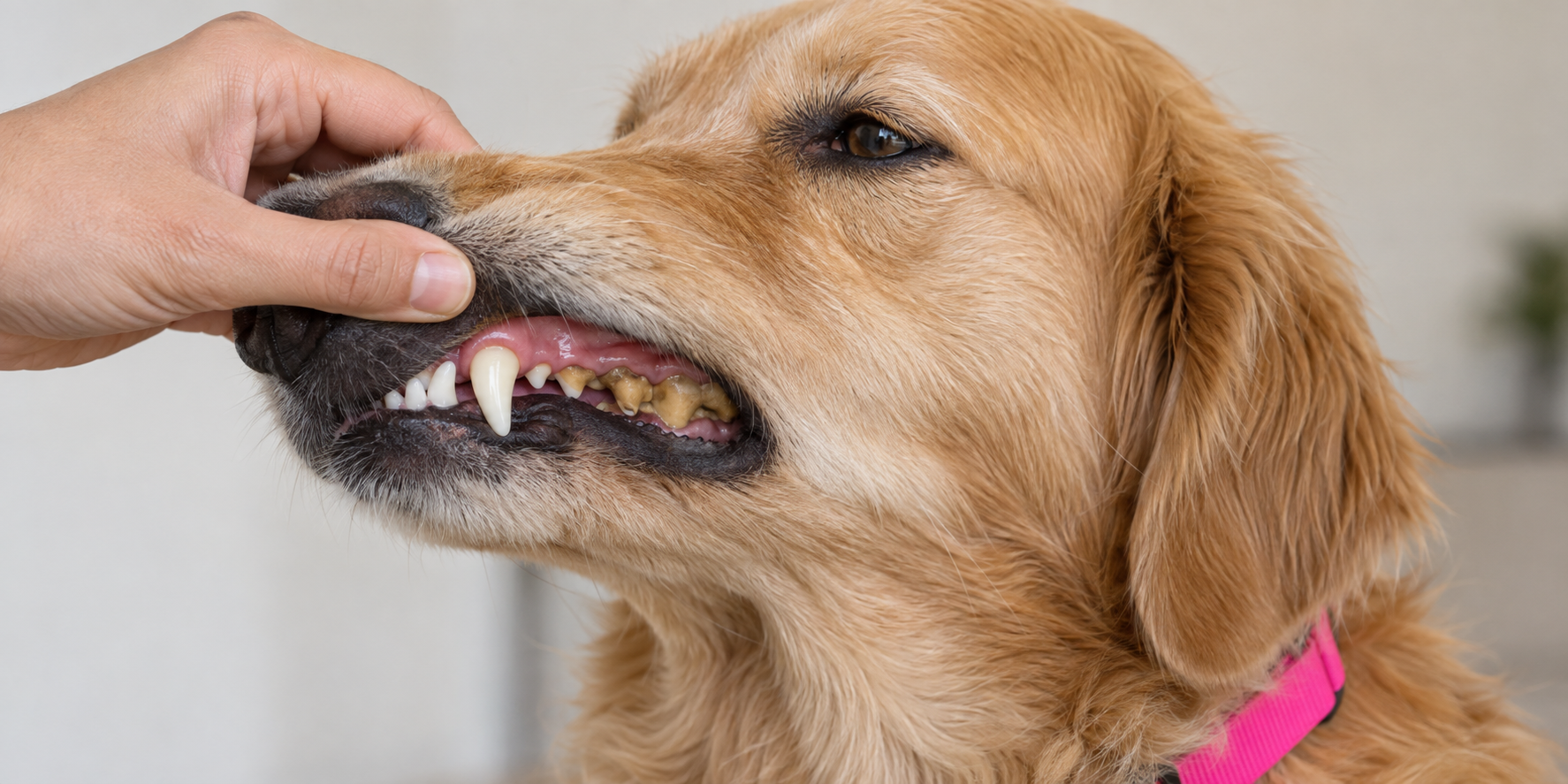
The reason is quite sad when you sit with it. A dog with a painful mouth carries on eating. They do not stop and they do not make a fuss about it.
They get on with it, and you have no idea.
Brushing is the only thing that reliably works, and the AVMA calls it the single most effective thing an owner can do between cleanings. It works best when it started long before it mattered. Dental chews and water additives help around the edges and there is nothing wrong with them, but they are not the thing.
What people get wrong here is waiting for a sign. Bad breath is not an early sign, it is a late one. Lift the lip and look at the back teeth every couple of weeks. Four seconds, and it is more or less the entire intervention.
How much does it cost to neuter a dog, and when should you do it?
Nobody can quote you a real number off a page, because it moves by state, by clinic and by the size of the animal.
That is worth saying plainly, because the cost question is the one people actually type and the answers they find are usually somebody else's region. Call two clinics and a local low cost program and you will have a true range for where you live in about ten minutes, which no article can give you.
The timing has moved more than the price has. The thinking shifted over the last ten years and it varies by species, by sex, by breed and by size. For larger dogs in particular there is now a reasonable case for waiting longer than we used to, and your veterinarian will have a view on where your animal sits in it.
What is not in dispute is that it is worth making a decision rather than drifting past it. And whatever you decide, write down what your veterinarian advised and when, because the follow-up question, months or years later, is always how old they were at the time.
What does a dog grooming routine actually involve?
Ten minutes a week with your hands, and the hands matter more than the brush.
How often you brush is about coat type rather than length. Anything with an undercoat or feathering will mat, and it mats against the skin where you cannot see it until it has become a problem.
The part that pays for itself is the handling. Feet, ears, mouth, every day, followed by something nice. Do that in the first few months and you have quietly bought yourself ten years of easier grooming, easier medicating and much calmer veterinary visits. Skip it and every one of those becomes a wrestle for the rest of their life.
This is the one job on the page with no clock at all, which is exactly why it gets dropped. Nothing reminds you. Nothing is overdue. It just silently decides how every other job on this list is going to go.
How much should you feed, and what else is on the list?
Whatever keeps the ribs findable and the waist visible, which is rarely the number printed on the bag.
Feeding guidelines are written for an average animal at an average activity level, which is nobody's actual pet. A working collie and a collie who lives in an apartment and does two walks a day are the same animal on paper and nothing like each other in the kitchen.

So use the animal rather than the chart. You want to feel the ribs without pressing, and see a waist looking down from above.
Changing food matters more than people expect: a gut that has settled on one thing takes a week or more to adjust to another, which is why switching abruptly causes an upset that then gets blamed on the new food. Usually it was not the food. It was the speed.
And the thing that catches nearly everyone is counting only meals. Training treats count. Chews count. The last inch of somebody's toast counts.
Appetite is worth watching in the other direction too. A dog who skips one dinner is usually nothing. A cat who skips one is not, and it is one of the few things on this page where the answer is a call today rather than a wait and see. Why a cat stops eating is covered on its own page, with what to have ready when you phone.
Behavior. Most of what looks like a training problem is a communication problem. A dog yawning in the waiting room is not tired. A shake-off after something tense is not nothing, it is a reset. Cats run the same system on a quieter setting, which is why what a cat's ears and eyes are saying is the half most owners never learn to read. Even the sleeping is information, and knowing how much sleep is normal is what lets you notice when it changes. Losing a companion is one of the changes that shows up there, which is why whether cats grieve after another pet dies gets a page of its own.
The microchip. There is no national requirement here and the rules that do exist are state or local, so the chip is not the point. The registration is.
The AVMA's own position is that a microchip only does its job once it is registered with a registry and the contact details are current. A chip registered to an apartment you moved out of two years ago is a chip that does nothing at all.
What should you set up before an emergency?
Two phone numbers and a kit, on a calm afternoon rather than at the worst possible moment.
Pet care mostly runs on a monthly or an annual clock. This part runs on hours. Find out where your nearest emergency veterinary hospital is and what they charge just to walk in, and put the ASPCA Animal Poison Control Center, (888) 426-4435, somewhere you can find it without searching. There is a consultation fee and it is the cheapest part of the evening.
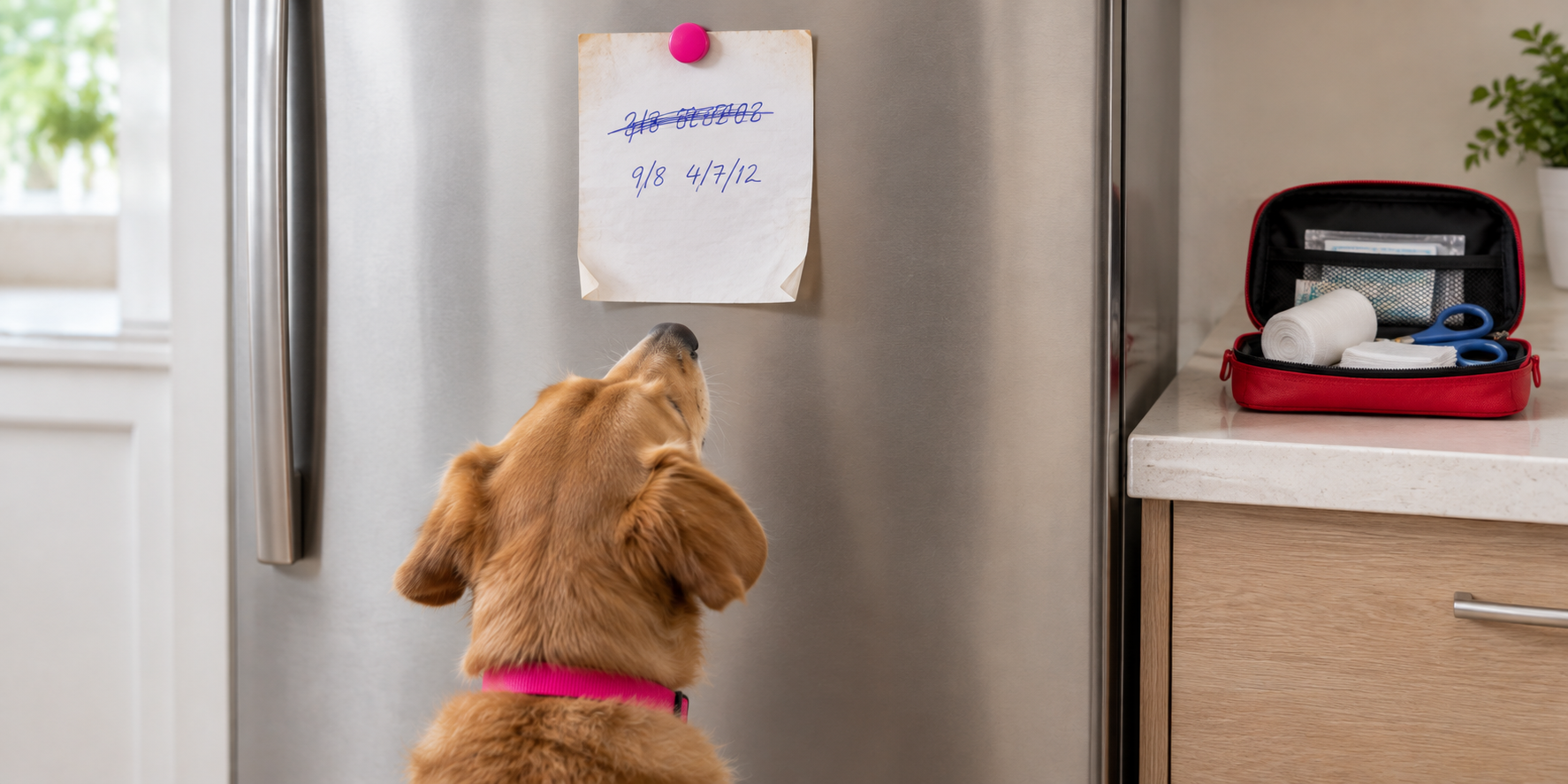
The signs that mean call now rather than see how they are in the morning: collapse, difficulty breathing, repeated retching that brings nothing up especially with a swollen belly, seizures, bleeding you cannot stop, anything you suspect they have eaten that they should not have, and a male cat straining in the litter box and producing nothing.
That last one gets missed constantly, because it looks like constipation and it is not. What else a change in litter box habits can mean is a separate question with a separate answer.
Hazards rotate through the year and each one catches a fresh set of owners. Foxtails and grass awns in late summer. Antifreeze when it gets cold. Chocolate and xylitol all year round.
And lilies, which are a cat problem specifically: Cornell's list of feline poisons says they can cause life threatening kidney failure in a cat that swallows even a tiny amount.
If you are reading this at eleven at night with a worried animal next to you, stop reading and call the emergency number. The rest of this page will still be here tomorrow.
Why is pet care hard when none of it is hard?
Because nearly all of it is a date, and a date you cannot find is a date you never had.
Read back up this page and notice how much of it is one. When the last shot was and which combination it covered. When the preventive is due and which product it was.
When somebody last properly looked at the teeth. What the veterinarian said about neutering and how old they were when they said it. Which food, and when it changed.
There is no single correct pet care schedule, and anybody selling you one is guessing. There is your animal, your veterinarian, your product and your dates. The value was never in knowing the general rule. It is in being able to find your own answer at the moment somebody asks you for it.
None of it is complicated. All of it is the sort of thing you get told once and are then expected to carry for a decade, usually while holding something. That is the thinking behind giving your pet their own page on pookii: one place the dates live, rather than a drawer, a text thread and your memory, which was never going to hold them anyway.
What else do people ask?
How often should you deworm a dog?
It depends on the product and on the dog's weight, not on their age. Most adult treatments land at monthly or every three months. Check the label on the one you actually have in the cupboard, and check the weight band again as a puppy grows, because they outgrow it faster than you would think.
How do I know if my dog has intestinal parasites?
Often you cannot, which is exactly why prevention runs to a schedule rather than to symptoms. When there are signs they are usually segments like grains of rice around the back end or in the bedding, a pot belly in a puppy, scooting, or weight loss on a normal appetite. A dog can carry a burden and look completely well.
Do indoor cats need vaccines?
Usually yes, and flea prevention too, which surprises people. Fleas arrive on clothing and on other pets, and several of the vaccines cover things that do not need another cat present. Rabies is also a legal question for cats in many places, not only a medical one. Ask your veterinarian what applies where you live.
What should be in a dog first aid kit?
Self-adhesive bandage wrap, sterile dressings, a tick remover, blunt-ended scissors, a foil blanket, and your emergency clinic's number written on paper rather than living only in your phone.
When should you neuter a dog?
Later than the old advice, and the size of the dog is what moves the answer most. Large breeds have a reasonable case for waiting longer. Your veterinarian will have a view on where your animal sits, and the thing to record is what they advised and how old the dog was when they advised it.