If your dog has been bitten or scratched by, or had contact with, a bat, raccoon, skunk or fox, call your veterinarian today, whatever the certificate says. Otherwise, the rabies vaccine for dogs runs on a simple sequence: a first dose at 3 months or older, a booster one year later, then a booster every one or three years, set by the vaccine and your local law.
The shot itself takes a few seconds. Your dog spends them staring at the exam room door, then forgives everyone the moment a treat appears. Rabies is one of the core shots every dog needs, next to distemper and parvo, and it sits on the wider vaccination schedule on its own terms.
But this one is different from the rest. Your state, county or city can require it, and the proof is a piece of paper that is easy to file and forget.
At what age is the puppy rabies shot given?
At 3 months or older. Every licensed rabies vaccine for dogs in the US is labeled for that age.
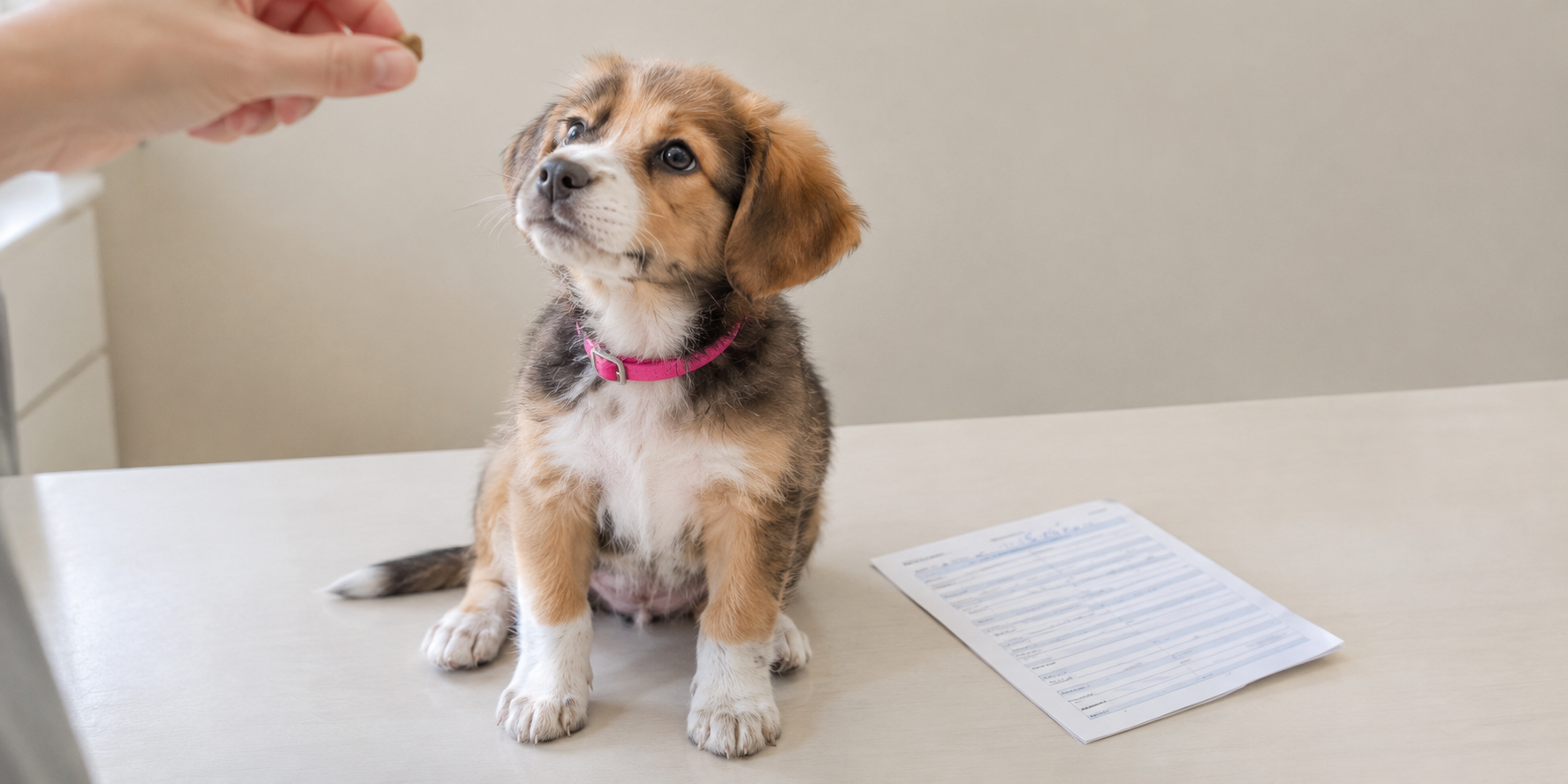
Your local law can set the exact age, so your vet may give it at 12 weeks or a little later, often alongside the last round of puppy shots. The puppy rabies shot does not protect on the day it is given. The CDC considers a dog immunized 28 days after the first dose.
So a puppy who had the shot last week is not covered yet. That window is a separate clock from when a puppy can go out in public, which is set by the distemper and parvo series rather than by rabies.
How long does rabies vaccine last in dogs?
One year for the first booster, then one or three years, depending on which vaccine your dog gets and what local law accepts.
The first booster comes one year after the first dose, whatever age the puppy was. The American Animal Hospital Association (AAHA) says it exists to immunize any dog that did not respond the first time.
After that, your dog follows the schedule of the vaccine used. Every licensed rabies vaccine for dogs is a killed vaccine, made in 1-year and 3-year versions. Two dogs on the same street can be due in different years, and the certificate is the only place the difference is written down.
A 3-year label is not a permission slip, though. AAHA's rabies guidance notes that local rules can set the age at the first dose, the timing of boosters, which version is accepted and what happens when a booster is late. If your county wants a yearly shot, the county wins.
Who sets the rules for the rabies vaccine for dogs?
Your state, county or city, and in many places more than one of them applies at once.
"My dog never goes outside" is not an exemption. The American Veterinary Medical Association (AVMA) notes that many state and local vaccination laws apply to indoor-only pets too. Where the rules differ between places, AAHA says vets generally follow the rules where the dog lives. Legal exemptions exist only in some places, and they are a conversation with your vet about your dog's health, written into the record.
Before booking a titer test to skip a booster, know that it will not count. AAHA says antibody levels have not been established as a measure of rabies protection, so testing is not a substitute for the shot.
What happens if an overdue dog is exposed to rabies?
It depends on the records: with proof of earlier shots, a booster and a 45-day home watch; without proof, a four-month quarantine.
On an ordinary day, an overdue dog just gets a booster. The CDC says a dog with any vaccination history counts as vaccinated again immediately after that booster, even if it was late.
After an exposure, the records decide what happens next. Under the 2016 national rabies guidance, as summarized by the AVMA:
- Up to date and exposed: a booster, then 45 days of observation at home under your control.
- Overdue, with records of earlier shots: treated the same as an up-to-date dog.
- Overdue, with no records: a booster and a strict four-month quarantine, unless public health officials agree to blood tests that show the immune system responded.
- Never vaccinated: euthanasia is the primary recommendation. The alternative is vaccination and a four-month quarantine.
Read the second and third lines together. Two dogs with the same shots, one with paperwork and one without, can face a 45-day home watch or a four-month quarantine. Your state or local health department applies these rules, and some go further.
What should you keep from each rabies shot?
The certificate, every time. Before you leave the clinic, check that it shows:
- The date the shot was given
- The vaccine name, and whether it is the 1-year or 3-year version
- The date the next one is due
- The clinic and the veterinarian who gave it
That is the information a health officer works from after an exposure. A rabies tag on the collar helps, but it is a number, not a vaccine history.
What are the side effects of a rabies shot for dogs?
Usually a sore spot, some tiredness or a mild fever, and they tend to pass within 24 hours.
The AVMA lists tenderness and swelling where the shot went in, tiredness, mild fever and a smaller appetite as common, minor reactions. Call your vet straight away for collapse, vomiting or diarrhea that keeps going, severe coughing, red itchy bumps all over the body, or swelling around the face, eyes or neck. If your dog has reacted to a vaccine before, say so before the needle comes out, not after.
Do dogs still get rabies in the US?
Rarely, and almost always from wildlife rather than from other dogs.
Of the roughly 5,000 animal rabies cases reported to the CDC each year, more than 90 percent are in wildlife, mostly bats, raccoons, skunks and foxes. If your dog may have had contact with any of them, call your vet and your local health department.
Who asks to see the rabies certificate?
Your vet asks for it, and so can a groomer, a boarding kennel and the county license office. But it only really matters once, after an exposure. Then a health officer needs a date and a vaccine, and the gap between 45 days and four months can come down to whether you can show them. Those dates belong with the rest of their history rather than in a glovebox, which is part of what it means to give your pet their own page on pookii.
What else do people ask about rabies shots?
When can a puppy get a rabies shot?
At 3 months of age or older, which is what every licensed US rabies vaccine for dogs is labeled for. Your local law may set the exact age, so ask your vet at the first puppy visit.
How long is a rabies shot good for in dogs?
The first rabies shot is followed by a booster one year later. After that, a dog's rabies shot is good for one or three years, depending on the vaccine used and what local law accepts.
How long after the rabies vaccine is it effective in dogs?
A dog is considered immunized 28 days after its first rabies dose. Until then, it does not count as protected, which matters most for a puppy that meets wildlife in its first month after the shot.
Can a rabies titer test for dogs replace the vaccine?
No. AAHA says antibody levels are not an established measure of rabies protection in dogs, so a titer test is not a substitute for the rabies vaccine.
Sources
[1] American Animal Hospital Association. 2022 AAHA Canine Vaccination Guidelines: Rabies.
[2] Centers for Disease Control and Prevention. Information for veterinarians: rabies.
[3] American Veterinary Medical Association. Vaccinations, client brochure, 2022.
[4] American Veterinary Medical Association, JAVMA News. New guidance for pets exposed to rabies, 2016.
[5] Centers for Disease Control and Prevention. Rabies in the United States.