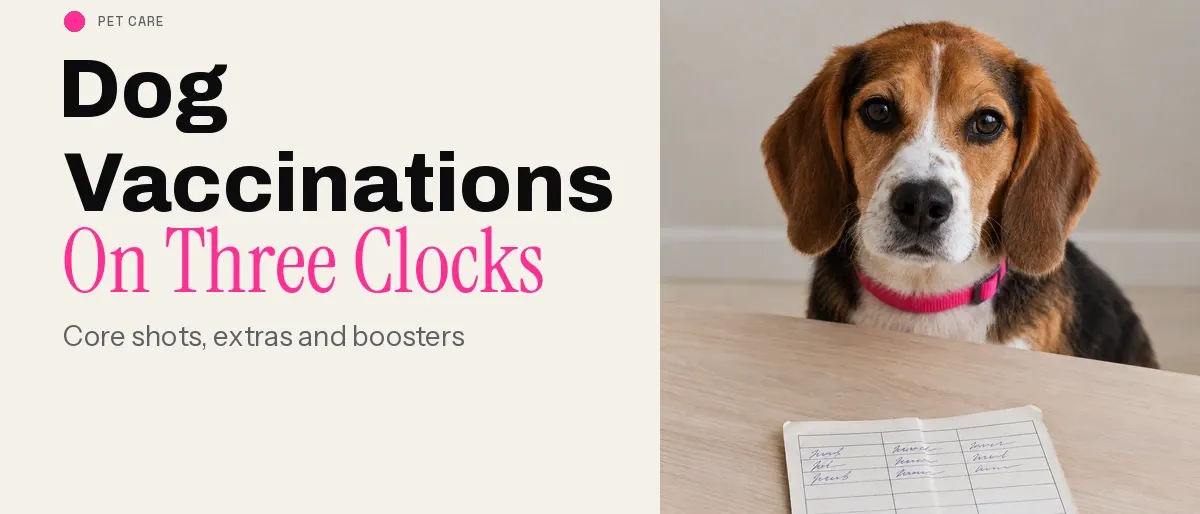
Dog vaccinations come in two groups. Core vaccines are recommended for every dog: distemper, adenovirus, parvovirus, leptospirosis and rabies. Noncore vaccines, such as Bordetella, Lyme and canine influenza, depend on where your dog goes and what it meets. Puppies get a series of shots, then a booster within a year, then most core boosters move to every three years. That is the framework in the American Animal Hospital Association (AAHA) canine guidelines, and your veterinarian fits it to your dog.
The vaccines are the easy part. The hard part is remembering, eighteen months later, which shot was which. If you want the picture across dogs and cats together, our guide to pet vaccinations covers both. This page is just the dog.
Which dog vaccines are core?
Five, under AAHA’s 2022 guidelines: distemper, adenovirus type 2, parvovirus, leptospirosis and rabies.
Distemper, adenovirus and parvovirus usually travel together in one combination shot, which your clinic might write as DAPV or DHPP.
Leptospirosis is the one owners are most often surprised to see on the list. AAHA counts it as core for dogs that go outdoors, in a city or the countryside. If your dog has never had it, raise it at the next appointment.
Rabies is the one with legal weight. AAHA times it as required by law, and the AVMA notes that many local and state laws require certain vaccinations even for indoor-only pets, rabies in particular. Because those laws vary, your veterinarian is the person who knows the local rule.
What does a puppy vaccination program look like?
At least three combination shots between 6 and 16 weeks of age, spaced 2 to 4 weeks apart, then one booster within a year.
The reason for a series rather than a single shot is that puppies arrive with borrowed protection. If their mother was vaccinated, antibodies in her milk give them some cover, but the AVMA says that protection is not long-lasting, and a young immune system is not mature enough to manage alone. The repeated doses carry them across that gap.
Leptospirosis runs on its own clock: two doses, starting at 12 weeks, 2 to 4 weeks apart. Rabies follows the legal timing where you live.
| Vaccine | Puppy start | Afterwards |
|---|---|---|
| Distemper, adenovirus, parvovirus (one combination shot) | At least 3 doses between 6 and 16 weeks, 2 to 4 weeks apart | One booster within a year, then every 3 years |
| Leptospirosis | 2 doses from 12 weeks, 2 to 4 weeks apart | Every year |
| Rabies | As required by law | As required by law |
| Bordetella and parainfluenza, if at risk | One dose into the nose | Every year |
| Canine influenza, if at risk | 2 doses, 2 to 4 weeks apart | One booster within a year, then every year |
Source: AAHA 2022 Canine Vaccination Guidelines, core and noncore table.
Until the series is finished, the outside world needs a little planning. We cover how soon a puppy can head out after the second round, and what is reasonable before then.
Which vaccines depend on your dog’s lifestyle?
Bordetella, Lyme, canine influenza and the rattlesnake toxoid. AAHA calls these noncore, meant for dogs whose lives put them at risk.
The AVMA’s examples make the logic plain. A Lyme vaccine makes sense for a dog in an area full of ticks. Bordetella and canine influenza make sense for a dog that boards, goes to daycare or spends its weekends nose to nose with strangers. A dog whose social life is one sofa and one human has a different risk profile.
The kennel cough shot is where expectations go wrong. Kennel cough is not one germ. The AVMA describes it as a complex of bacteria and viruses, including Bordetella, parainfluenza and adenovirus type 2, spread through shared bowls, toys and coughs. The intranasal vaccine covers those three, so it lowers the risk without making a dog untouchable. A vaccinated dog that comes home from boarding with a honking cough has not proved the vaccine worthless. Most dogs with kennel cough recover fully within 7 to 10 days, according to the AVMA. [3] Lethargy, fever, a poor appetite or fast, labored breathing are different, because they can mean the lungs are involved, and that needs a vet promptly.
Do dog vaccinations need boosting every year?
Not all of them. After the first booster, AAHA puts the distemper, adenovirus and parvovirus combination on a three year cycle.
So why does the reminder card arrive every year? Because leptospirosis, Bordetella and canine influenza are yearly, and rabies follows whatever the law in your area says. An annual visit is usually a mix of whichever shots are due.
Which is why “Is she up to date?” is harder than it sounds. Five vaccines on three different clocks will defeat most memories.
What side effects are normal after puppy vaccines?
Mild ones: a tender or swollen spot, tiredness, a slight fever or a smaller appetite, usually gone within 24 hours.
The AVMA suggests calling your vet if those mild effects last more than a day or two, or if a firm swelling where the shot went in lasts more than three weeks or keeps growing.
Some signs need care straight away: fainting or collapse, repeated vomiting or diarrhea, persistent severe coughing, difficulty breathing, red itchy bumps all over the body, or swelling around the face, nose, eyes or neck. It is worth keeping an eye on your dog for the rest of the day after any round of puppy vaccines.
How do you keep track of your dog’s vaccinations?
Keep three things together: the vaccine, the date it was given, and the date the next one is due.
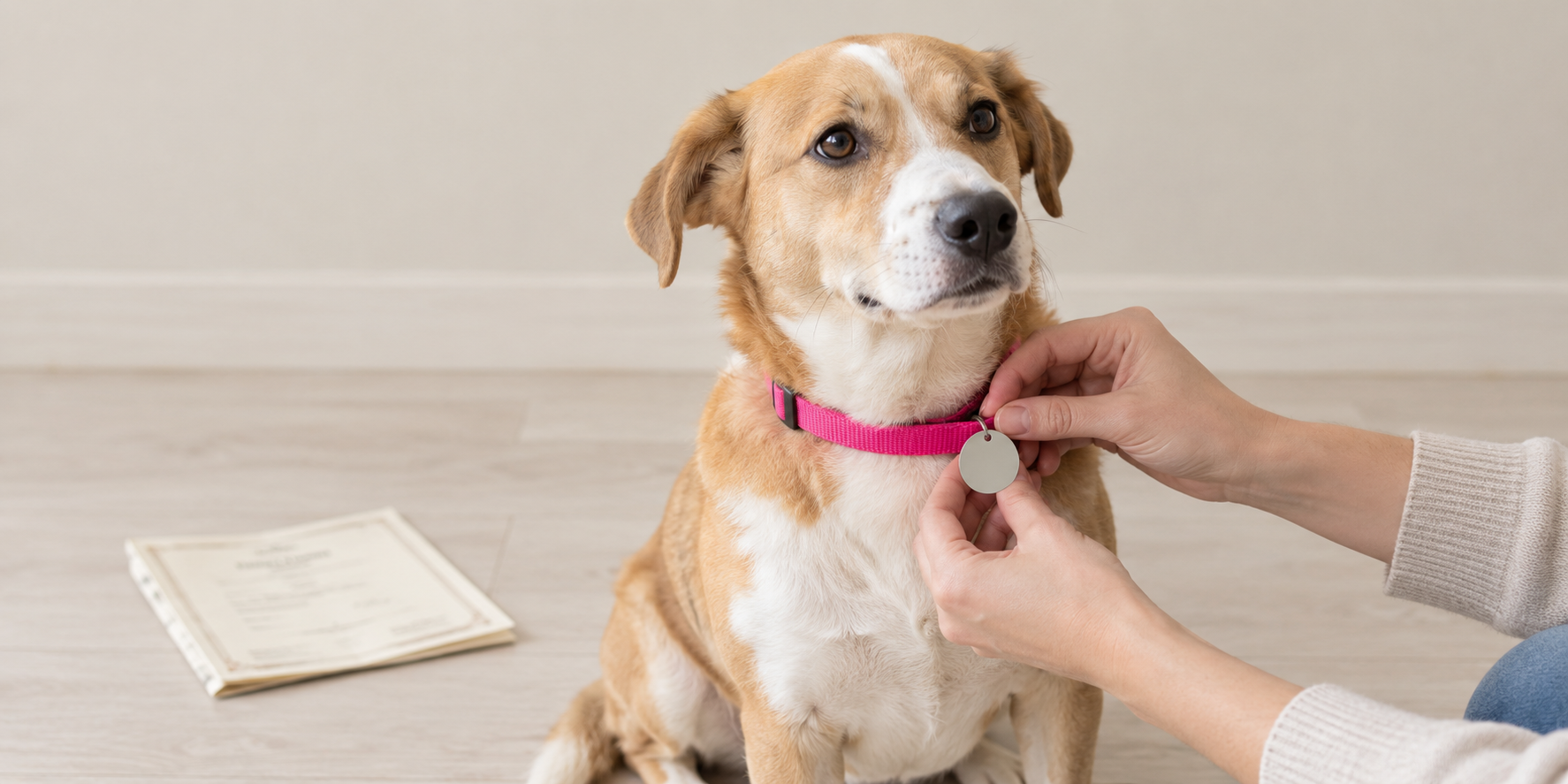
The certificate from the clinic carries all three, which is exactly why it disappears. Photograph it the day you get it. Ask the clinic for a printout of the full history at the annual visit, because the kennel, the groomer and any new vet will all ask for some part of it. And if you change clinics, carry the history with you rather than assuming the records will follow.

The rhythm settles once you can see it. A puppy’s first year is busy, then the calendar thins into a yearly visit with a bigger round every third year. The record is what turns that from a guessing game into a glance, and it is the kind of detail pookii, the internet for pets, was built around: the dates sit beside the name, the photos and the people who look after your dog, so the answer is on their page when someone asks.
Questions about dog vaccines
Do indoor dogs need vaccines?
Yes. Core vaccines are recommended for every dog, and many local and state laws require rabies vaccination even for indoor-only pets. AAHA also treats leptospirosis as core because any dog that goes outdoors can be exposed.
Is the kennel cough vaccine required?
It is a noncore vaccine, so whether your dog needs it depends on risk. The AVMA recommends an annual intranasal vaccine against Bordetella, adenovirus type 2 and parainfluenza for dogs in certain at-risk groups, such as those that board or go to daycare.
How long do dog vaccines last?
After the first booster, the distemper, adenovirus and parvovirus combination is given every three years under AAHA’s guidelines. Leptospirosis, Bordetella and canine influenza are yearly, and rabies follows local law.
Why do puppies need several vaccine doses?
Antibodies from a vaccinated mother’s milk give puppies some protection, but it fades, and their own immune systems are still maturing. A series of doses between 6 and 16 weeks covers that gap.
What if my dog is overdue or the history is unknown?
Book the vet rather than waiting for a perfect record. AAHA’s guidelines say the benefits of vaccination far outweigh the risks for dogs with an unknown history, and sum it up as “when in doubt, vaccinate.” For overdue boosters, your vet follows the vaccine maker’s instructions.
Sources
[1] American Animal Hospital Association. Recommendations for core and noncore canine vaccines, 2022 AAHA Canine Vaccination Guidelines.
[2] American Veterinary Medical Association. Vaccinating your pet.
[3] American Veterinary Medical Association. Canine infectious respiratory disease complex (kennel cough).